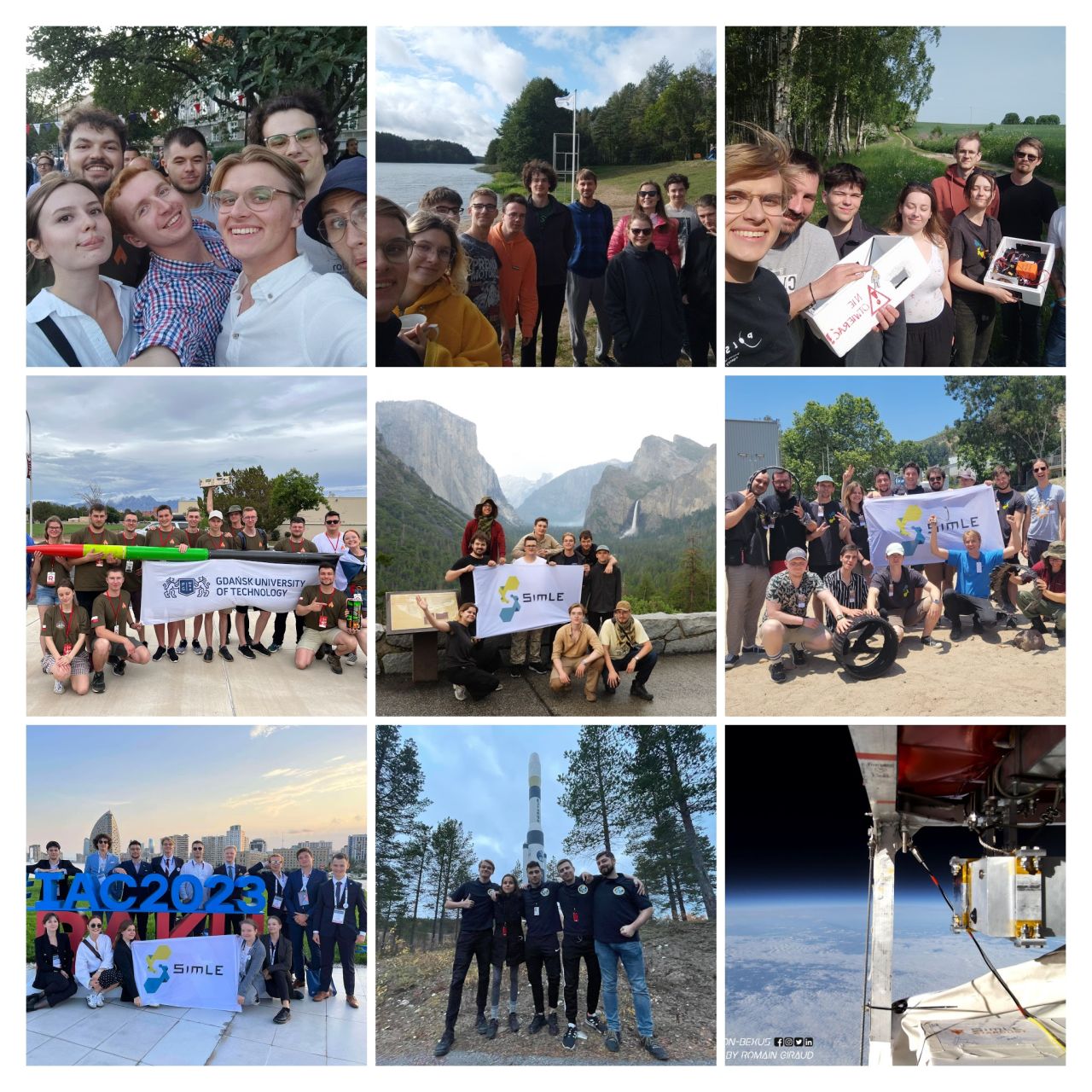
I'm excited to share that after five incredible years with the SimLE Science Club at Gdańsk University of Technology, including two years as President, I'm stepping down from my role.
I want to thank everyone I've worked with for the incredible journey we've had. Your dedication and passion have been the driving force behind our successes.
During my tenure as President, I had the privilege of supporting space projects that I'm especially proud of. I was happy to continue SimLE Stardust, our stratospheric balloon program, and helped liftoff SimLE SimBa, the construction of a hybrid sounding rocket.
These projects opened doors to amazing opportunities. I was fortunate to take part in the REXUS/BEXUS Programme, which involved launching the Stardust BEXUS Project on board the BEXUS 30 balloon from Esrange, Sweden. Additionally, we participated in international rocketry competitions like the Spaceport America Cup and the European Rocketry Challenge, as well as international events like the International Astronautical Congress (IAC).
Most of all I'm happy to had the opportunity to help many of my peers in finding support for all of our endeavors. It was an honor to represent our projects in front of the University and our partners.
Though I'm stepping down from my role, I'm still committed to supporting space exploration and scientific endeavors at Gdańsk Tech. I'm also here to mentor the next generation and continue to learn and grow with them.
I would like to wish all the best to Kuba Jabłoński, Magdalena Sadowska, and Maciej Zawadzki, who are taking on the responsibility as the new President and Vice-presidents of the Club. I have no doubt they'll continue to do great things.
As I step into new horizons, I'm reminded that the journey of discovery is infinite and boundless. The stars may be far, but they're within reach with dedication and innovation.
Ad Astra!
Looking back
I passed the baton in the summer of 2023, just before I left for my internship at ESA's European Space Operations Centre in Darmstadt. This post came a few weeks later. Here is a longer look back at my five years in the club, with links to the posts and sources from that time.
2018-2020: member of team Stardust
I joined SimLE at the start of my studies in 2018. After years of following SpaceX and building the rocket.watch website, a science club with a rocket team was the obvious choice - but I landed in the stratospheric balloon team, Stardust. I started with electronics, then programming, and later the system engineering of the balloon platform. My first big piece of work was the payload electronics and a wireless ESP8266 protocol for the flight computer, and the launch, tracking and recovery of the missions.
- Stardust Stratospheric Balloon Mission! (August 2020): the first flights with the new platform.
2020-2021: technical coordinator of Stardust BEXUS
In the REXUS/BEXUS programme of DLR, SNSA and ESA, I was responsible for the electronics of our experiment and for its technical coordination. On 30 September 2021, after two years of work, the experiment flew on board BEXUS 30 from Esrange in Sweden and collected samples of microorganisms from the stratosphere.
- Balloon EXperiment for University Students: the BEXUS 30 campaign.
- European Rocketry Challenge 2021: two weeks later, I helped the SimBa team at their launch in Portugal.
- Dubai Adventure - IAC 2021!: our first International Astronautical Congress, in October 2021.
- Autumn 2021 summary (in Polish): BEXUS 30, EuRoC, IAC 2021 in Dubai and the "Złote Lwiątko" award of the Student Government for the Student Scientist of the year.
- TVP3 Gdańsk visited the club twice that autumn: a live interview about Stardust and a report for the Inventor's Day about Stardust, SimBa and the Silverhand prosthetic hand (in Polish).
2021-2023: President
In November 2021, the club elected me as its President. At that time, SimLE had more than 100 students in five teams: SimBa (sounding rockets), Stardust (stratospheric balloons), Silverhand (a prosthetic hand with EMG control), SeaSentinel (a port monitoring drone), and the business and outreach section. A big part of my work was not engineering: I looked for partners and funding, represented the projects in front of the University, and helped the teams find support for their ideas.
- SimLE Science Club (December 2021): the club and its history, written just after the election.
- SimLE Stardust Mission (February 2022): a test flight from my home town, Iława.
- Engineering Thesis: Stardust (February 2022): my engineering thesis about the Stardust platform. In November 2022, it received the third-degree award of the President of the Polish Space Agency.
- First Stardust Results - PAC 2022 in Biarritz (May 2022): the first scientific results of the BEXUS experiment at the ESA PAC Symposium.
- Spaceport America Cup 2022 with AMBER (June 2022, in Polish): I designed the electronics of the AMBER biotechnology payload for our R6 rocket.
- Stardust in Paris - IAC 2022 (September 2022): four SimLE presentations at IAC 2022, including our BEXUS 30 paper.
- Stardust balloon mission from Iława (May 2023): a flight to 34 km with payloads from other research groups, the first step towards an open stratospheric platform.
- In 2023, we also started Stardust NEXT, to pass the knowledge about stratospheric balloons to the next generation of students.
TV interviews from that time (in Polish): "Student-naukowiec" in TVP Olsztyn, SimLE at BioTech Daily in TVP Gdańsk, and "Opinie Elbląg" in TVP Olsztyn about the POLSA award.
After 2023
The Stardust story did not end with my term. The team presented seven years of Stardust at IAC 2023 in Baku, and in 2024 we went back to the PAC Symposium with "Life After BEXUS". In 2026, Maciej Zawadzki is the President of the club, and SimLE still builds rockets, balloons and autonomous boats (Pismo PG, in Polish).
More
- SimLE and Stardust.
- Rakiety, balony wysyłane do stratosfery czy dron portowy? Dołącz do SimLE (WIMiO PG, October 2022, in Polish): the teams of the club during my term.
- Laureaci studenckiego plebiscytu Złote Lwiątka (Gdańsk Tech, in Polish).
The first part of this post first appeared on LinkedIn.